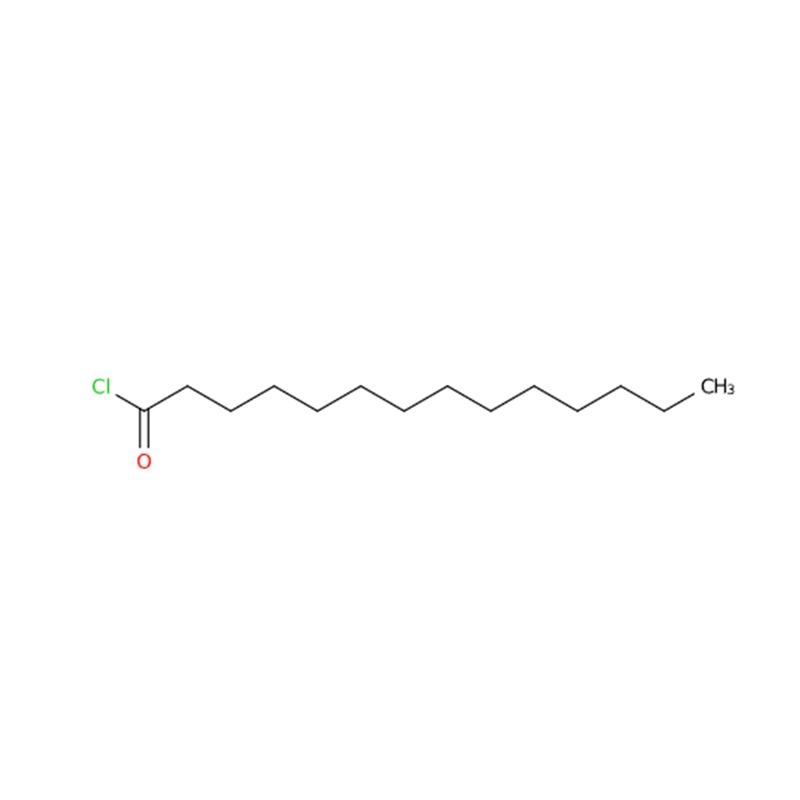
Product Description of Myristoyl Chloride CAS#112-64-1
Myristoyl Chloride, also recognized as tetradecanoyl chloride, is a highly reactive acyl chloride compound with the molecular formula C₁₄H₂₇ClO. This chemical presents as a colorless to light yellowish-brown oily liquid with a pungent and characteristic odor. It is sensitive to moisture and will hydrolyze when exposed to water to produce myristic acid and hydrogen chloride.
Synthesized based on myristic acid, a naturally sourced fatty acid, it possesses excellent chemical activity and functions as a reactive intermediate for molecular modification and coupling reactions in chemical synthesis. As an essential organic synthetic building block, it is widely utilized for the preparation of various lipid substances, surfactant products and specific pharmaceutical chemicals, occupying an important position in fine chemical and pharmaceutical synthesis processes.

Myristoyl Chloride Chemical Properties
| Melting point | -1 °C (lit.) |
| Boiling point | 250 °C/100 mmHg (lit.) |
| density | 0.908 g/mL at 25 °C (lit.) |
| refractive index | n20/D 1.449(lit.) |
| Fp | >230 °F |
| storage temp. | −20°C |
| form | Liquid |
| color | Clear colorless to light yellow-brown |
| Water Solubility | MAY DECOMPOSE |
| BRN | 636924 |
| InChIKey | LPWCRLGKYWVLHQ-UHFFFAOYSA-N |
| CAS DataBase Reference | 112-64-1(CAS DataBase Reference) |
| NIST Chemistry Reference | Myristoyl chloride(112-64-1) |
| EPA Substance Registry System | Tetradecanoyl chloride (112-64-1) |
| Hazard Codes | C |
| Risk Statements | 34-37-22 |
| Safety Statements | 26-36/37/39-45-28B |
| RIDADR | UN 3265 8/PG 2 |
| WGK Germany | 3 |
| F | 46316 |
| HazardClass | 8 |
| PackingGroup | III |
| HS Code | 29159000 |

Product Application of Myristoyl Chloride CAS#112-64-1
Myristoyl Chloride is a key acylation intermediate for fine chemical manufacturing. It is widely used to produce surfactants and emulsifiers applied in cosmetics, detergents and textile additives.
Myristoyl Chloride can attach a 14-carbon fatty-acid chain, also referred to as a fatty tail, to target molecules. Such chemical modification, commonly called myristoylation, helps modified protein substances gain improved affinity for cell-membrane binding. This compound finds extensive adoption within biochemical research for investigating diverse cellular mechanisms.
It also shows practical value in pharmacological research work, where it helps optimize drug delivery performance and boost the cellular absorption efficiency of target drug molecules.