

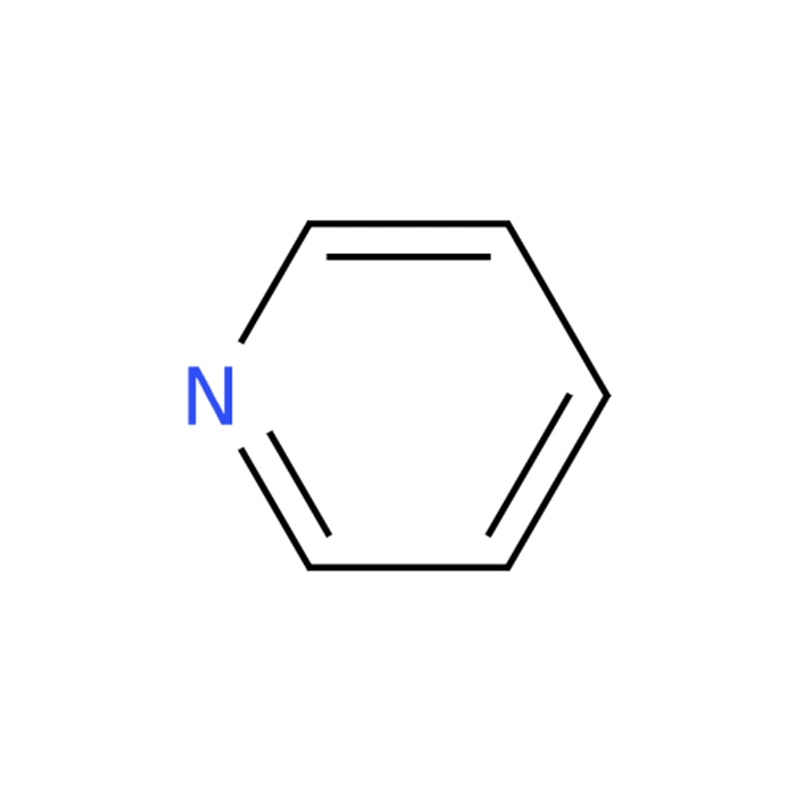
Product Description of Pyridine CAS#110-86-1
Pyridine, molecular formula C5H5N, belongs to six-membered nitrogen-containing heterocyclic aromatic substances. Its molecular framework comes from substituting one C-H unit of the benzene ring with a nitrogen atom. Thanks to its benzene-like aromatic trait and electronic arrangement, it also goes by the alias azabenzene.
Under ambient temperature, pyridine appears as colourless liquid with a characteristic smell. Its melting point hits -41.6°C and boiling point reaches 115.2°C, alongside the density value of 0.9819 g/cm³. It can create water-containing azeotrope boiling between 92-93°C, and this feature gets widely adopted for industrial purification. The chemical dissolves easily in water, ethyl alcohol, ether and the majority of organic solvents, and it is commonly employed as an industrial solvent.
People first separated pyridine out of bone tar. Afterwards, researchers discovered it inside coal tar, coal gas, shale oil and crude oil, together with methylpyridine, dimethylpyridine and other similar heterocyclic materials. When compared to benzene, pyridine and its derivatives possess superior stability, and their chemical activity is roughly equivalent to nitrobenzene.
The ring-located nitrogen atom reshapes electron distribution on the aromatic cycle. The 2-, 4-and 6-sites carry fewer electrons than position-3 and position-5. For that reason, electrophilic substitution mainly proceeds on the 3-and 5-carbon. Pyridine is less prone to nitration, halogenation and sulfonation reactions than benzene. On the contrary, low-density electrons at the 2-and 6-carbon favour nucleophilic substitution. Such property enables the preparation of 2-aminopyridine, 2-hydroxypyridine and other derivatives by reacting with proper nucleophilic reagents.

Pyridine Chemical Properties
| Melting point | -42 °C (lit.) |
| Boiling point | 115 °C (lit.) |
| density | 0.978 g/mL at 25 °C (lit.) |
| vapor density | 2.72 (vs air) |
| vapor pressure | 23.8 mm Hg ( 25 °C) |
| FEMA | 2966 | PYRIDINE |
| refractive index | n20/D 1.509(lit.) |
| Fp | 68 °F |
| storage temp. | Store at +5°C to +30°C. |
| solubility | H2O: in accordance |
| form | Liquid |
| pka | 5.25(at 25℃) |
| color | colorless |
| Odor | Nauseating odor detectable at 0.23 to 1.9 ppm (mean = 0.66 ppm) |
| Relative polarity | 0.302 |
| PH | 8.81 (H2O, 20℃) |
| explosive limit | 0.124 |
| Odor Threshold | 0.063ppm |
| Odor Type | fishy |
| Water Solubility | Miscible |
| FreezingPoint | -42℃ |
| λmax | λ: 305 nm Amax: 1.00 |
| λ: 315 nm Amax: 0.15 | |
| λ: 335 nm Amax: 0.02 | |
| λ: 350-400 nm Amax: 0.01 | |
| Merck | 147970 |
| BRN | 103233 |
| Henry's Law Constant | 18.4 at 30 °C (headspace-GC, Chaintreau et al., 1995) |
| Dielectric constant | 12.5(20℃) |
| Exposure limits | TLV-TWA 5 ppm (~15 mg/m3) (ACGIH, MSHA,and OSHA); STEL 10 ppm (ACGIH), IDLH 3600 ppm (NIOSH). |
| Stability: | Stable. Flammable. Incompatible with strong oxidizing agents, strong acids. |
| InChIKey | JUJWROOIHBZHMG-UHFFFAOYSA-N |
| LogP | 0.64 at 20℃ |
| CAS DataBase Reference | 110-86-1(CAS DataBase Reference) |
| IARC | 2B (Vol. 77, 119) 2019 |
| NIST Chemistry Reference | Pyridine(110-86-1) |
| EPA Substance Registry System | Pyridine (110-86-1) |
Safety Information
| Hazard Codes | T,N,F,Xn |
| Risk Statements | 11-20/21/22-39/23/24/25-23/24/25-52-36/38 |
| Safety Statements | 36/37/39-38-45-61-28A-26-28-24/25-22-36/37-16-7 |
| RIDADR | UN 1282 3/PG 2 |
| OEB | A |
| OEL | TWA: 5 ppm (15 mg/m3) |
| WGK Germany | 2 |
| RTECS | UR8400000 |
| F | 46091 |
| Autoignition Temperature | 482 °C |
| Hazard Note | Highly Flammable/Harmful |
| TSCA | Yes |
| HS Code | 2933 31 00 |
| HazardClass | 3 |
| PackingGroup | II |
| Hazardous Substances Data | 110-86-1(Hazardous Substances Data) |
| Toxicity | LD50 orally in rats: 1.58 g/kg (Smyth) |
| IDLA | 1,000 ppm |

Product Application of Pyridine CAS#110-86-1
Being a vital nitrogen-bearing heterocyclic substance, pyridine gets widely utilised within photocatalysis, optoelectronic material production and organic-chemistry preparation. The pyridine ring acts as a core structural fragment for numerous medicinal active molecules in pharmaceutical research.
Pyridine and its derived substances occupy an indispensable status across the drug-making sector. For instance, nicotinamide derived from pyridine-3-carboxylic acid amide constitutes an essential part of metabolic-related coenzymes. Isoniazid, another pyridine derivative, works as the common oral medicine against tuberculosis. Moreover, 2-methyl-5-vinylpyridine is one fundamental feedstock for synthetic rubber manufacturing.
Apart from drug-related usage, this compound works as an industrial solvent, denaturing reagent and textile-dyeing additive. It can be processed into diverse finished goods covering medicines, sterilizing agents, colorants, food flavour additives, bonding agents and fine chemicals. Besides, plenty of research projects adopt pyridine for hydrogen-isotope exchange tests and catalyst-assisted molecular modification exploration.