

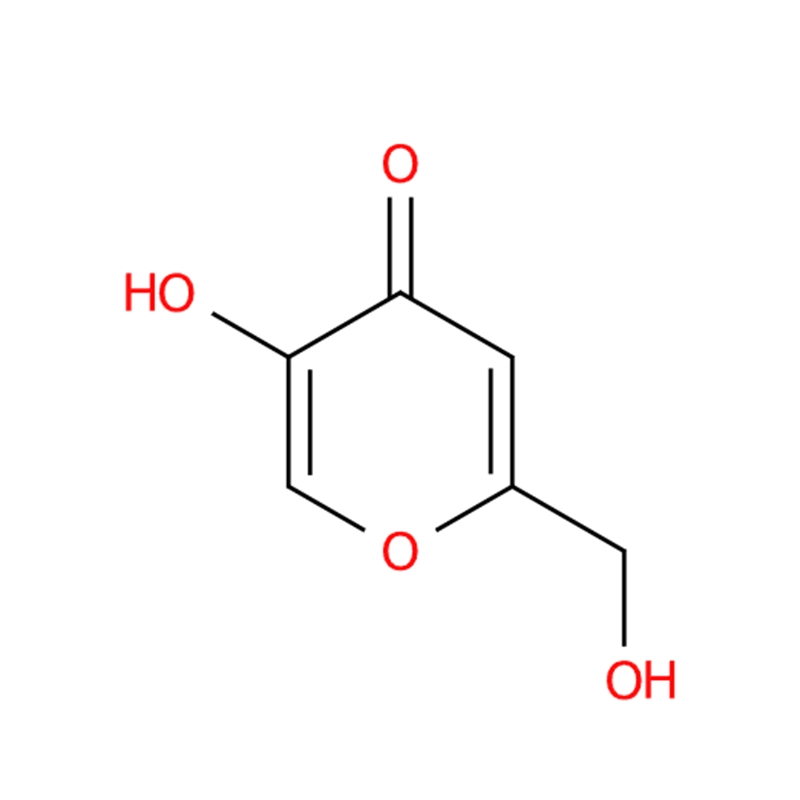
Products Description of Kojic Acid CAS#501-30-4
Kojic acid is an organic acid possessing antibacterial activity. It can be generated when glucose undergoes aerobic fermentation by Aspergillus candida under 30–32 °C. Chemically, it falls into the category of substituted γ-pyrones. Kojic acid and maltol are the best-known naturally existing γ-pyrone derivatives.
In 1907, Saito successfully separated crystalline kojic acid from rice koji. Yabuta formally assigned the compound its official name in 1912, followed by the confirmation of its chemical structure in 1924. Subsequent investigations further clarified its biosynthesis pathway: Arnstela carried out surface fermentation experiments in 1953, while Kitada Makuo conducted submerged fermentation research in 1971. Supported by isotope tracing analysis, these researches verified that kojic acid is synthesized through direct oxidation and dehydration of glucose, with no cleavage of the glucose carbon skeleton occurring.
Kojic acid Chemical Properties
Melting point | 152-155 °C (lit.) |
Boiling point | 179.65°C (rough estimate) |
density | 1.1712 (rough estimate) |
refractive index | 1.4434 (estimate) |
storage temp. | Store below +30°C. |
solubility | DMSO (Slightly), Methanol (Slightly, Sonicated) |
form | Crystalline Powder |
pka | 7.9(at 25℃) |
color | White to beige-brown |
Water Solubility | SOLUBLE |
λmax | 269nm(CHCl3)(lit.) |
Merck | 145317 |
BRN | 120895 |
Stability: | Stable. Combustible. Incompatible with strong oxidizing agents. |
LogP | -0.64 |
CAS DataBase Reference | 501-30-4(CAS DataBase Reference) |
NIST Chemistry Reference | 5-Hydroxy-2-(hydroxymethyl)-4h-pyran-4-one(501-30-4) |
IARC | 3 (Vol. 79) 2001 |
EPA Substance Registry System | Kojic acid (501-30-4) |
Hazard Codes | Xn |
Risk Statements | 40-68 |
Safety Statements | 22-24/25-36/37-36 |
WGK Germany | 3 |
RTECS | UQ0875000 |
HS Code | 29329995 |
Hazardous Substances Data | 501-30-4(Hazardous Substances Data) |

Product Application of Kojic Acid CAS#501-30-4
Applications in the Food Industry
Kojic acid enjoys broad application within the food manufacturing sector. Thanks to its antioxidant characteristics, it was first adopted to stop oils from going rancid. Newer research has further confirmed its antibacterial and insecticidal activities. It acts as a food preservative, fresh-keeping agent and colour stabilizer, acting as a viable substitute for traditional synthetic preservatives. It is commonly adopted for colour retention during meat processing, and for sterilization and preservation of fruits, vegetables and raw food materials. Additionally, it works as a preservative for cut flowers to prolong their freshness and shelf life. Moreover, kojic acid is capable of suppressing nitrosamine generation derived from nitrites in cured meats. This property carries great importance for enhancing food safety and facilitating product upgrading. In agricultural fields, kojic acid can be deployed as a biopesticide, insecticide and bio-fertilizer. Spraying it onto crops or applying it to plant root systems helps boost crop output and productivity.
Production of Flavors and Food Additives
Kojic acid acts as a key raw material to synthesize flavor enhancers including maltol and ethyl maltol.
Pharmaceutical Applications
It can be utilized as an intermediate for manufacturing cephalosporin antibiotics.
Cosmetics and Personal Care Applications
Apart from food-related uses, kojic acid is extensively incorporated into cosmetic formulas for skin brightening and fading pigment spots. Kojic acid and its derivatives such as acetate derivatives display antibacterial performance with relatively low skin irritation, qualifying them as preservatives for cosmetics and food goods. Kojic acid features powerful UV absorption capacity, and can be utilized independently or compounded into sunscreen products. It is widely added to skincare formulations to lighten pigmentation, retain skin hydration and reduce wrinkles. It also shows potential anti-dandruff effects when added to hair care items.
Other Industrial Applications
Kojic acid can also be used in seasonings, and serves as feedstock for producing larch bark extract and ethyl larch bark extract.