

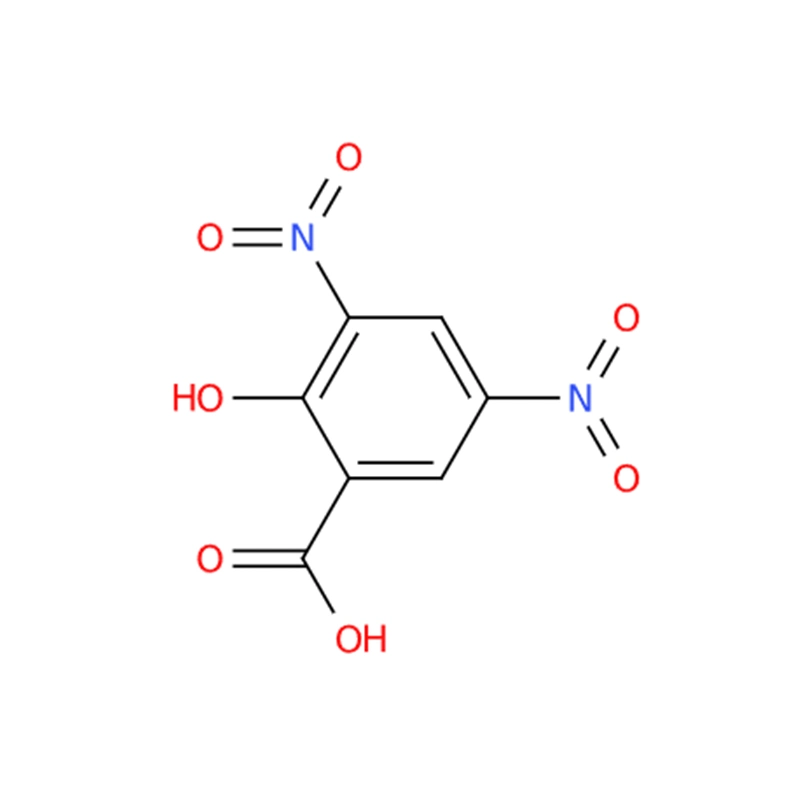
Products Description of 3,5-Dinitrosalicylic Acid CAS#609-99-4
Better known under the abbreviations DNS and DNSA, 3,5-Dinitrosalicylic Acid (CAS#609-99-4) belongs to the family of aromatic organic acids. The chemical presents as a yellow crystalline powder. Its melting-point range equals 168-172°C, and the estimated boiling point reaches 369.91°C. It dissolves in alcohols, benzene and ether solvents, and possesses limited solubility in cold water while readily soluble in hot water.
This well-known laboratory substance is primarily employed in spectrophotometric testing targeted at reducing-sugar content. Benefiting from stable detecting capacity, the compound is commonly used for carbohydrate measurement and the detection of enzymatic activity.

3,5-Dinitrosalicylic Acid Chemical Properties
| Melting point | 168-172 °C (lit.) |
| Boiling point | 369.91°C (rough estimate) |
| density | 1.7914 (rough estimate) |
| refractive index | 1.5300 (estimate) |
| storage temp. | room temp |
| solubility | H2O: soluble50mg/mL |
| form | Powder |
| pka | 1.57±0.10(Predicted) |
| color | Yellow |
| PH Range | 1.3-1.8 (10g/L @ 20°C) |
| Water Solubility | soluble |
| BRN | 2220661 |
| Stability: | Stable. Incompatible with strong oxidizing agents, strong bases, strong acids. |
| LogP | 0.12 at 23℃ and pH2.6-2.8 |
| CAS DataBase Reference | 609-99-4(CAS DataBase Reference) |
| NIST Chemistry Reference | 3,5-Dinitrosalicylic acid(609-99-4) |
| EPA Substance Registry System | Benzoic acid, 2-hydroxy-3,5-dinitro- (609-99-4) |
| Hazard Codes | Xn,Xi |
| Risk Statements | 22-37/38-36/37/38 |
| Safety Statements | 22-24/25-36-26 |
| RIDADR | 2811 |
| WGK Germany | 3 |
| RTECS | VO2965000 |
| Hazard Note | Irritant |
| TSCA | Yes |
| HazardClass | 6.1(b) |
| PackingGroup | III |
| HS Code | 29182990 |

Product Application of 3,5-Dinitrosalicylic Acid CAS#609-99-4
3,5-Dinitrosalicylic Acid works both as a fine-chemical intermediate for drug-related synthesis and a laboratory-testing agent for glucose detection.
Its most frequent usage covers quantitative analysis on reducing-sugar substances. Benefiting from the distinctive colour-developing reaction of its nitrated salicylic-acid derivatives, the DNS testing technique has turned into a classic standard approach for detecting multiple reducing sugars such as glucose and maltose.
Apart from carbohydrate testing, this compound takes part in enzyme-activity measurement. Researchers quantify reducing-sugar products set free from catalytic reactions of amylase, glycoside hydrolase and other biocatalysts. The measured yield helps workers assess the catalytic performance of target enzymes.