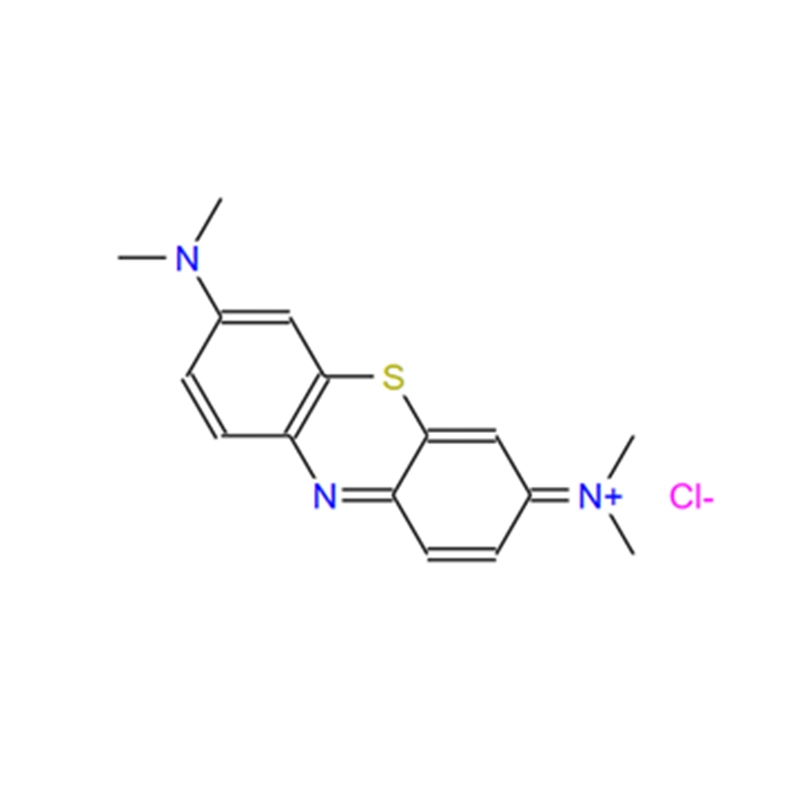
Product Description of Methylene Blue CAS# 61-73-4
Methylene blue (MB) is a reducing agent with high water-solubility and favourable cell-membrane permeability. It exhibits low toxic side effects and has obtained clinical drug approval. First introduced into biological research in the 19th century, methylene blue has been extensively utilised as a staining agent in neuroanatomy and bacteriology. Within biochemical studies, it acts as an indicator for redox reactions. For clinical practice, methylene blue functions as an antidote for nitrite-induced and other toxin-triggered methemoglobinemia; additionally, it is adopted for the management of cyanide poisoning and ifosfamide-associated encephalopathy.
Methylene Blue Chemical Properties
Melting point | 190 °C (dec.)(lit.) |
density | 1.0 g/mL at 20 °C |
refractive index | n20/D1.347 |
Fp | 45 °C |
storage temp. | room temp |
solubility | Soluble in water, ethanol, ethylene glycol, methyl cellosolve |
form | Liquid |
pka | 2.6, 11.2(at 25℃) |
Colour Index | 52015 |
color | Green |
Specific Gravity | 0.98 |
Odor | Odorless |
Water Solubility | 40 g/L (20 ºC) |
λmax | 661 nm |
Merck | 146060 |
BRN | 3641570 |
Biological Applications | Detecting microorganisms; treating diabetic retinopathy,macular degeneration,malignant uveal melanomas, erysipelas, hidradenitis suppurativa,inflammation,skin diseases |
NIST Chemistry Reference | Methylene blue(61-73-4) |
EPA Substance Registry System | Methylene blue (61-73-4) |
Safety Information
Hazard Codes | Xn |
Risk Statements | 10-41-22-20/21/22-36/37/38 |
Safety Statements | 26-39-36 |
RIDADR | UN 1993 3/PG 3 |
WGK Germany | 3 |
RTECS | SP5740000 |
HS Code | 32049010 |
Hazardous Substances Data | 61-73-4(Hazardous Substances Data) |
Toxicity | LD50 oral in rat: 1180mg/kg |
Product Application of Methylene Blue CAS# 61-73-4
Methylene blue is a non-toxic dye that occurs in two states: an oxidized blue form and a colourless reduced form. During the staining of viable yeast cells, robust cellular metabolic activity reduces methylene blue, converting its blue hue to colourless. In contrast, cells with low metabolic activity or dead cells fail to exert reducing capacity and consequently take on blue or pale-blue colouration. This characteristic enables morphological observation of yeast cells as well as differentiation between viable and non-viable cells.
Furthermore, methylene blue finds extensive use in dyeing linen, silk textiles, paper, bamboo and wood, alongside the manufacturing of inks and pigment lakes. It is also applicable for staining biological and bacterial tissue samples. When blended with basic purple 5BN and yellow dextrin at a proportion of 78:13:9, basic royal blue can be obtained, broadening its scope within colour-formulation and textile sectors.